Review de Apex Trader Funding
Una review a fondo y en primera persona de Apex Trader Funding escrita por Kane Simons, además de 114 reviews verificadas de traders, sus reglas, la velocidad de los payouts y el código de descuento actual.

Kane Simons (TraderKane) is the founder of Prop Firm Compare and a futures trader with 10+ years' experience. Having earned $3.5 million in prop firm payouts, he provides unbiased reviews, comparisons and insights based on real trading experience.
Cómo se ha hecho esta review
Bought the accounts with my own money, no sponsored or gifted account.
Passed the evaluations, traded 20 funded accounts at once on Tradovate and had $1,926,240 approved in one morning on 31 August 2024.
Traded under Apex's older structure, now called Legacy, so the current accounts rebuilt on 1 March 2026 are assessed on the published rules.
La review de Kane sobre Apex Trader Funding

Kane Simons (TraderKane)
Founder, Prop Firm Compare · bought, passed, traded funded and had $1,926,240 approved across 40 payouts from 20 accounts
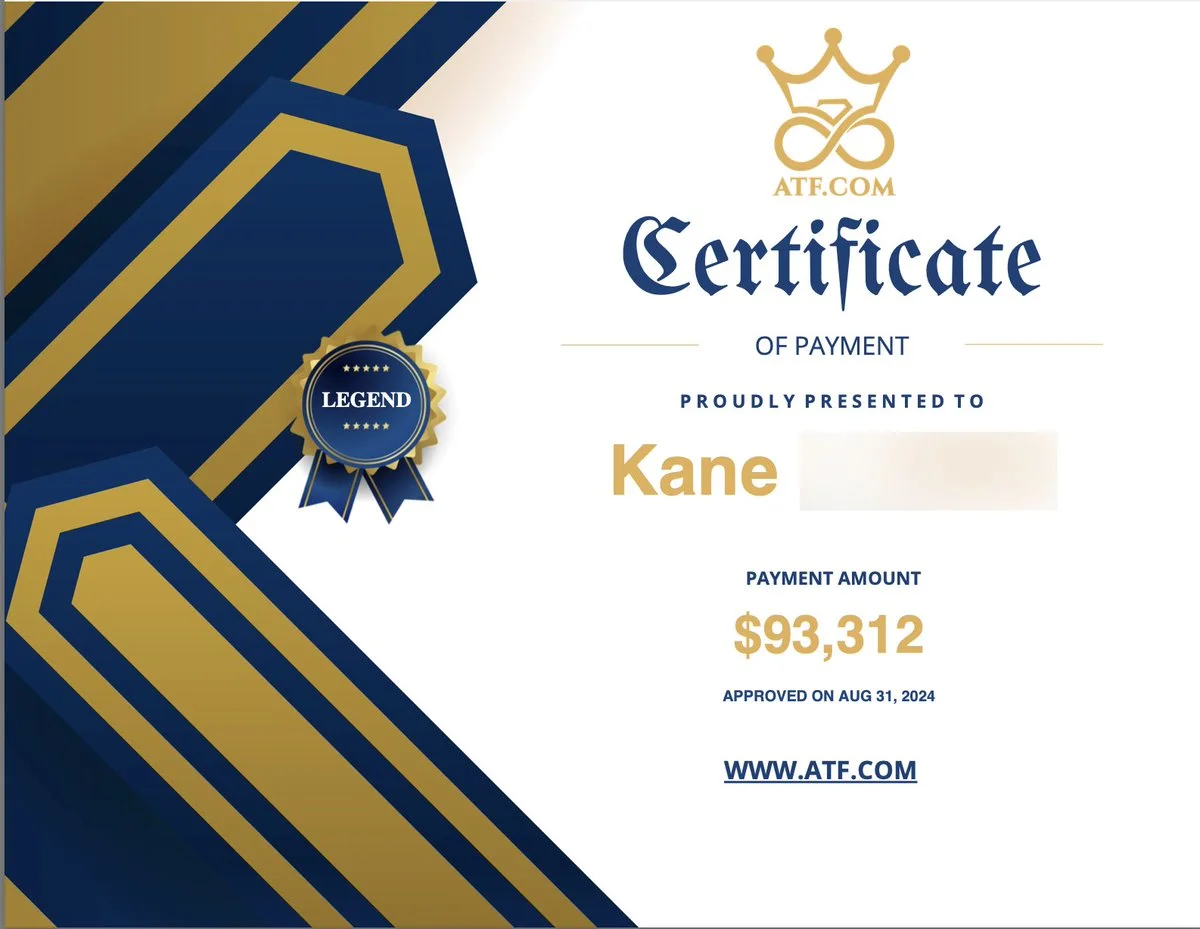
Apex is where I took the single largest payout of my trading career, and as far as I know the largest in prop firm history: $1,926,240 approved in one morning on 31 August 2024, made up of 20 payouts of around $93,000 and 20 of $3,000. I bought those accounts with my own money, passed them, traded them funded and got paid. What makes Apex different is the account cap. You can run 20 at once, and when a good run lands it lands across all of them. One thing to be straight about: that was under Apex's older structure, now called Legacy. They rebuilt the whole product line on 1 March 2026, so what I traded is not their standard product today. Legacy evaluations do come back as limited time promotions, but the rules below describe the current accounts.
Lo que me gustó
Up to 20 accounts at once, which is what turns a good month into a payout of that size
100% payout split on approved withdrawals under the current structure, the highest in the space
No consistency rule during the evaluation, and no minimum trading days, so a clean session can pass it
Choice of end of day or intraday trailing drawdown, so you pick the model that fits how you trade
One time fees with no recurring billing on current accounts, and a choice of Standard or No Activation Fee plans at checkout
No payout reviews, no chart screenshots and no video checks before a payout is approved
Simple payout setup: ACH direct deposit for US traders, and Plane for international traders
Evaluations are cheap with code LAB: a 50K end of day account was $59 on the Standard plan, and a 50K intraday account $24.90, with five packs bringing those to $49 and $19 each
A tener en cuenta
Apex rebuilt its products on 1 March 2026, so older reviews, mine included, describe rules that no longer apply to new accounts
On the Standard plan you pay an activation fee after passing, so check which plan you are buying before you compare prices
Payouts can take a while to arrive. They do pay, but this is not the firm to pick if speed matters most
There are no resets on current evaluations. Breach and the account is gone, so you buy a new one rather than resetting
The end of day accounts carry a daily loss limit, $1,000 on a 50K, which the intraday accounts do not
A 50% consistency rule applies on funded accounts even though the evaluation has none
Each payout needs 5 qualifying days, a cleared safety net and at least $500 available before you can request
Each funded account allows a maximum of 6 payouts on a stepped cap ladder
Evaluations expire after 30 calendar days with no extensions, and you have 7 days to activate after passing
Running 20 accounts multiplies your costs as well as your upside, and hedging between your own accounts is not allowed
My Experience With Apex Trader Funding
I traded on Tradovate and used code LAB at checkout, which is the Prop Firm Compare code. On current pricing a 50K end of day evaluation on the Standard plan comes to $59 with the code, down from $590, or $245 for a five pack at $49 each. When the whole point of the firm is running several accounts, the five pack is the obvious way in.
Apex is the firm that rewards scale more than any other, and the payout record on my accounts is a direct result of that. Twenty accounts means one good setup, traded the same way across all of them, produces twenty payouts rather than one. That is the whole argument for the firm, and it is why the August 2024 number looks the way it does.
It cuts both ways. Twenty evaluations cost twenty times as much, and twenty accounts can breach on the same bad session just as easily. Copy trading in the same direction across your own accounts is allowed, hedging between them is not, so the strategy has to be one you are willing to run at that width.
Apex now sells every account two ways. The Standard plan has a lower evaluation price and an activation fee once you pass. The No Activation Fee plan costs more upfront and nothing afterwards. If you expect to pass, the second option removes a cost you would otherwise pay later. If you are less sure, Standard keeps the money you risk on a failed evaluation lower. Both are one time payments with no recurring billing, which is a change from the Legacy accounts, which billed monthly until cancelled.
On the current structure, the evaluation is the easy part: no consistency rule, a one day minimum, and a pass available in a single clean session if you hit the target without touching drawdown. On a 50K end of day account that means $3,000 profit inside a $2,000 drawdown and a $1,000 daily loss limit, with 6 minis or 60 micros. Evaluations stay active for 30 days and cannot be reset, so a breach means buying a new one. The funded account is where the rules live. A 50% consistency rule applies, five qualifying days are needed before each payout, and each account is capped at six payouts on a stepped ladder. Current pricing and codes are on the Apex discount codes page, and the full lineup is on the challenges page.
My Payout Experience
On 31 August 2024, Apex approved $1,926,240 across my accounts in a single morning: 20 payouts of roughly $93,000 and 20 of $3,000. As far as I know that is the largest payout in prop firm history, and it is certainly the largest I have ever taken.
The part worth understanding is how it happened. Not one enormous trade, but the same approach repeated across 20 funded accounts, each one paying out on its own. The account cap is the product. Everything else about Apex, good and bad, follows from it.
Apex has since moved payouts onto an automated system with several withdrawal methods, and the current structure pays 100% of approved requests. What has also changed is the ladder: under the current rules each account caps at six payouts, with five qualifying days and a safety net required each time. My run predates all of that.
Payouts can take some time to land. They do pay, and they paid me more than any other firm I have used, but Apex is not the firm to choose if fast cash out is your priority. If it is, look at the comparisons further down.
That is my own record, not a promise of what anyone else will see, and it was earned under rules Apex has since replaced. Payout timing and eligibility now depend on your drawdown type, your qualifying days and where you sit on the payout ladder.
Payout verified — certificate of payment, $93,312 approved 31 August 2024, one of 40 payouts totalling $1,926,240.
Which Account Would I Choose?
Kane's Pick: end of day drawdown on the No Activation Fee plan, at whatever size you can afford to run several of
The drawdown choice matters more than the account size, and on a 50K it is a straight trade between price and model.
Intraday is less than half the price and has no daily loss limit. The catch is that the drawdown follows your unrealised profit in real time, so an open winner lifts your floor before you have banked anything. End of day only moves after the close, so a position that dips and recovers before the session ends does not cost you the account, though you can still breach it during the session if price moves past the existing limit.
I would still take end of day. The intraday model is the reason most traders who breach do so, and the price difference is small next to the cost of losing an account you have already passed.
On the fee plan, I would pay upfront and skip the activation fee if you are confident in your approach, since across several accounts those fees add up quickly. Size is a budget question. The real decision at Apex is how many accounts you run, since the firm is built around stacking them. Start with a number you could lose without it hurting, then scale once your approach survives a full payout cycle. Compare the sizes on the challenges page.
Who I Would Recommend Apex Trader Funding To
Choose Apex Trader Funding if you want to run several accounts at once and have a repeatable approach worth copying across them. Nothing else in the space scales like 20 accounts on a 100% split, and my own payout record is the evidence.
If you want one account with simpler rules and faster payouts, compare Lucid Trading or Tradeify. My main reason for recommending Apex is simple: it paid me $1,926,240 and never argued about it.
Preguntas frecuentes de la review de Apex Trader Funding de Kane
The end of day drawdown product over the intraday one, since the limit only moves after the close rather than following unrealised profit. Intraday is cheaper, $24.90 against $59 on a 50K with code LAB, and has no daily loss limit, but the drawdown model is harder to trade. Take the No Activation Fee plan if you are confident of passing. Size matters less than how many accounts you run, because Apex is built around stacking up to 20 at once.
The evaluation is approachable, with no consistency rule and no minimum trading days. The funded account is stricter, with a 50% consistency rule, five qualifying days per payout and a six payout cap per account. Beginners should also avoid stacking accounts until one has survived a full payout cycle.
Apex rebuilt its products on 1 March 2026, so older reviews describe rules that no longer apply. On current accounts, watch the 50% funded consistency rule, the five qualifying days per payout, the six payout cap per account, and the 30 day evaluation window.
Yes. Code LAB is the Prop Firm Compare code and the one Kane used. With it, a 50K end of day evaluation on the Standard plan was $59, or $49 each in a five pack. Check the Apex discount codes page for the current offer.
Traders with a repeatable approach who want to run it across several accounts at once. The 20 account cap and 100% split reward scale more than any other firm, which is also why it suits experienced traders more than beginners.
Nothing matches it for scale: 20 accounts on a 100% split. The trade is complexity, since the funded rules include consistency, qualifying days and a payout ladder that simpler firms like Lucid Trading do not have.
The funded rules are more involved than most: a 50% consistency rule, five qualifying days per payout, a six payout cap per account and a safety net to clear. Running 20 accounts also multiplies costs and risk, not just upside.
Compara Apex Trader Funding con otras prop firms
Los puntos fuertes de Apex frente a la mayoría de la competencia son el profit split del 100%, el límite de 20 cuentas y que permite operar noticias. Donde se queda atrás es en flexibilidad: no hay resets, hay un tope de 6 payouts por Performance Account y cobra una tarifa de activación que algunas prop firms no cobran.
Tradeify, Take Profit Trader y Lucid Trading son las alternativas con las que más se compara. Lucid no tiene tarifa de activación; Apex la cobra cuando apruebas.
Puedes ver cómo queda Apex en precios, reglas de drawdown y profit split en nuestras comparativas completas.